
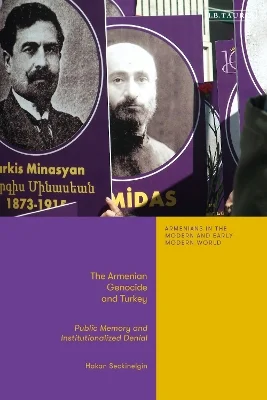
Description
By (author) Seckinelgin Hakan
Short /annotation:
An examination about how state-sanctioned official knowledge and denial of the Armenian genocide in Turkey is produced, maintained and regulated and its implications from 1915 to the present day.
:
How is official denial of the Armenian genocide maintained in Turkey? In this book, Hakan Seckinelgin investigates the mechanisms by which denial of the events of 1915 are reproduced in official discourse, and the effect this has on Turkish citizens. Examining state education, media discourse, academic publications, as well as public events debating the Armenian genocide, the book argues that, at the public level, there exists a ‘grammar’ or ‘repertoire’ of denial in Turkey which regulates how the issue can be publicly conceptualised and understood. The book’s careful analysis examines the way that knowledge about the genocide is censored in Turkey, from the language that must be used to publicly discuss it, to the complex way in which selective knowledge and erased history is reproduced, from 1915 and subsequent generations until today. It argues that denialism has become important to a certain kind Turkish national identity and belonging – and suggests ways in which this relationship can be unpicked in future.
Table of contents:
Acknowledgements
1.Introduction
2.The Memory Machine: The Armenian Genocide in Turkey
3.Commemorating the Centennial of the Armenian Genocide: 24 April 2015
4.Public Memory and the Mass Media
5.Formal Education: Creating Citizens
6.Educating the Public
7.Conclusion
Review quote:
This excellent book analyzes the significance of collective remembering and forgetting in modern Turkey; state and government actors employ manufactured public memories in social media and education to produce and maintain the denialist public discourse on the 1915 events.
Biographical note:
Hakan Seckinelgin is a Professor in International Social Policy at the London School of Economics and Political Science, UK. He is the author of International Security, Conflict and Gender (2012), and was an Editor in Chief of the Journal of Civil Society
Promotional headline:
An examination about how state-sanctioned official knowledge and denial of the Armenian genocide in Turkey is produced, maintained and regulated and its implications from 1915 to the present day.
for collection:
Recent decades have seen the expansion of Armenian Studies from insular history to a broader, more interactive field within an inter-regional and global context. This series, Armenians in the Modern and Early Modern World, responds to this growth by promoting innovative and interdisciplinary approaches to Armenian history, politics, and culture in the period between 1500-2000. Focusing on the geographies of the Mediterranean, Middle East, and Contemporary Russia [Eastern Armenia], it directs specific attention to imperial and post-imperial frameworks: from the Ottoman Empire to Modern Turkey/Arab Middle East; the Safavid/Qajar Empires to Iran; and the Russian Empire to Soviet Union/Post-Soviet territories.
Reflecting the interdisciplinary nature of the field, the series welcomes proposals from scholars in Ottoman/Turkish Studies, Iranian Studies, Slavic Studies, Middle Eastern Studies, Mediterranean Studies, and disciplines of History, Political Science, Anthropology, Literature and Sociology, among others.
Topics and themes include, but are not limited to, the following areas:
– Trade and economy
– Cultural production
– Political history
– Gender
– Intra and inter-religious relations
– Diaspora
– Genocide
– Nationalism and Identity formation
– Democratization




Reviews
There are no reviews yet.